From Folklore to Futurism: The Evolution of Roma Aesthetics
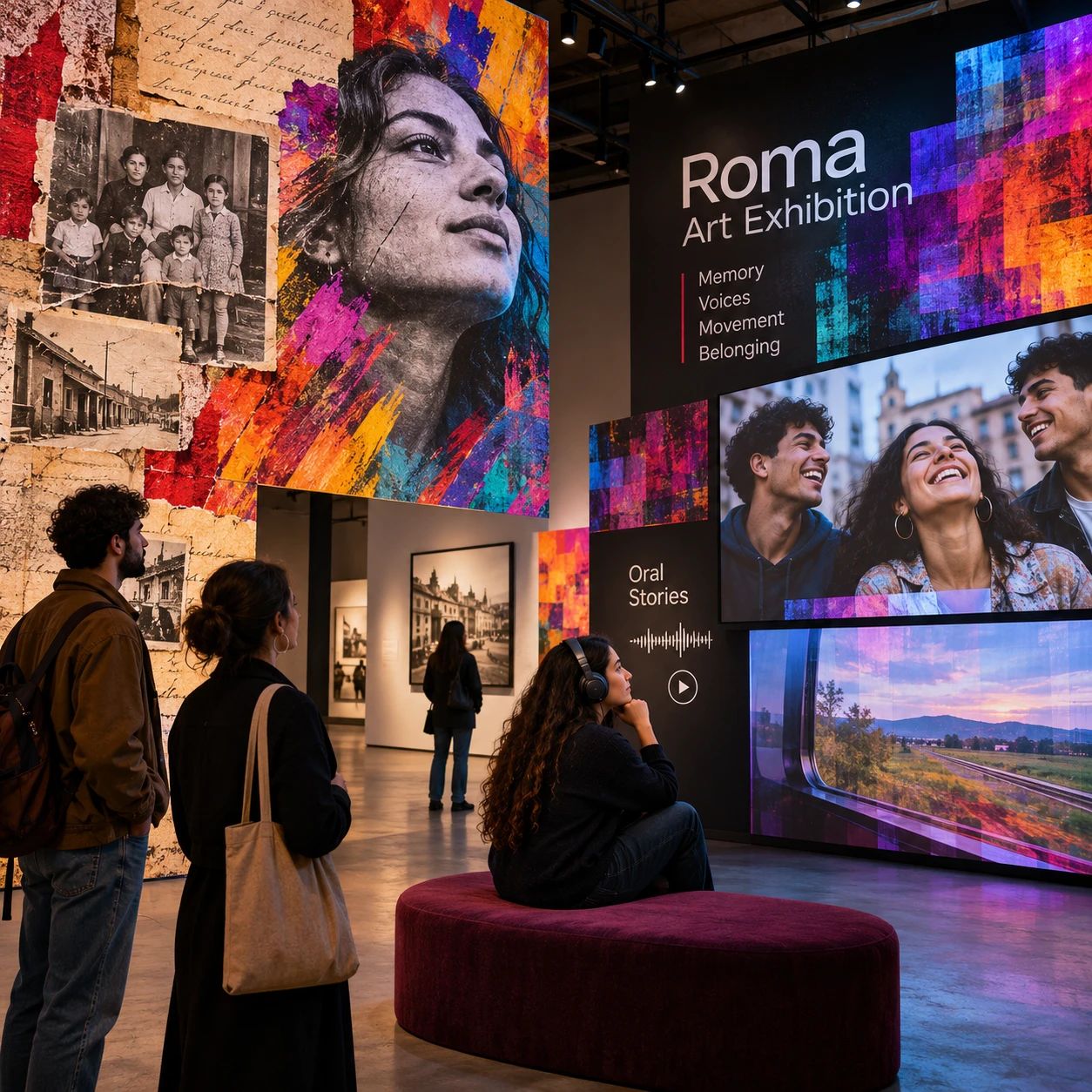
Roma art cannot be reduced to a single look, origin story, or set of symbols. Its aesthetics take shape across diverse communities and individual experiences, bringing inherited knowledge into conversation with the realities and possibilities of the present.
Following Roma aesthetics from folklore to futurism is not a straight path away from tradition. It is a way to see how artists carry memory, question imposed images, and choose new forms of self-representation. Roma-led platforms, including the Roma Art Biennale, help make room for that wide-ranging conversation.
What Do We Mean by Roma Aesthetics?
Roma aesthetics refers to the varied ways Roma artists shape meaning through image, sound, material, movement, and space. It is not one defining style; it changes with community, place, generation, and lived experience.
Roma communities are diverse, with distinct histories and cultural practices. A painting, performance, or installation by a Roma artist may draw on family memory, urban life, political experience, regional visual culture, or ideas that have little apparent connection to familiar depictions of Roma identity. No single artwork can stand in for everyone.
It is useful to think of aesthetics as a set of choices rather than a checklist of motifs. An artist may use color, composition, archival material, language, or sound to explore belonging and visibility. Another may avoid explicit cultural references altogether. Both choices can be meaningful expressions of artistic agency.
Roma cultural heritage is living and plural. Treating it as a fixed visual category risks overlooking the people who create, interpret, and change it.
Folklore, Memory, and Visual Traditions
Folklore and visual traditions can inform Roma art through stories, music, craft, and inherited memory. Their influence is personal and changing, rather than a universal code that every Roma artist must use.
Oral tradition is one important way communities carry knowledge across generations. Stories, songs, and spoken histories can preserve experiences that formal archives have ignored or recorded from outside perspectives. Artists may respond to this inheritance through text, sound, performance, or images that suggest how memory travels and shifts.
Music and craft can also offer artistic vocabularies: rhythms translated into visual patterns, objects reworked as sculpture, or familiar materials used to evoke family and place. These approaches do not mean that any material or motif belongs exclusively to Roma culture. Meaning depends on context, authorship, and the artist’s relationship to what is being represented.
Folklore is a resource, not a test of authenticity. An artist who works with inherited stories may be asking who gets to tell them and how they change; an artist who does not use folklore is no less connected to Roma identity. Continuity can include reinterpretation, disagreement, and new forms.
Moving Beyond Stereotypes and External Gaze
Roma artists’ self-representation matters because images of Roma people have often been shaped by outsiders and repeated as stereotypes. Artists can challenge those conventions by deciding what to show, how to show it, and whose perspective guides the work.
Romanticized depictions may frame Roma life as timeless, exotic, or defined by movement and spectacle. Such images can appear admiring while still flattening different people and histories into a familiar fantasy. They tell viewers what to expect, leaving little space for ordinary life, political complexity, humor, or individual choice.
Self-representation shifts that balance. A photograph, film, or installation can confront the viewer’s assumptions, reclaim a family archive, or make visible experiences missing from public records. The aim is not to establish one authorized image of Roma identity. It is to widen the range of images and voices, including work that resists easy interpretation.
For audiences and curators, a practical question helps: Who made the work, whose perspective does it center, and what context does it need? Those questions encourage more careful engagement than simply labeling an artwork authentic or representative.
Contemporary Roma Art and New Forms
Contemporary Roma artists work across painting, photography, installation, performance, film, and other media. They may draw on heritage while addressing current social realities, personal histories, and questions that cross cultural boundaries.
A photograph can examine how identity is staged or documented. An installation might bring archival fragments into dialogue with objects from daily life. Performance can use gesture, voice, or audience participation to explore who is seen and heard. These forms do not replace older traditions; they create different ways to approach memory and experience.
Working across media also allows artists to control how audiences encounter a subject. A gallery object may invite close looking, while a live performance changes with the people in the room. Each format has limits: a powerful image can still lose context when circulated online, and an installation may reach fewer people than a digital work. Presentation and interpretation matter alongside medium.
For viewers, it helps to begin with the work itself: notice its materials, scale, and point of view before searching for a cultural label. That approach leaves room for both artistic specificity and the broader realities an artist may be addressing.
Futurism, Technology, and Changing Identities
Futurism in Roma art can use technology and speculative imagination to picture possible futures while staying connected to present-day life and inherited memory. Digital forms do not require artists to abandon heritage.
Digital and multimedia art can combine moving images, sound, text, animation, or interactive elements. These tools may help artists question who controls archives, how identities are represented online, and what kinds of futures public culture can imagine. A speculative scene can challenge the assumption that Roma identity belongs only to the past.
Technology is a medium, not a guarantee of innovation. Digital works can travel widely, but online circulation can strip away context or expose artists to misreading. Some projects also depend on access to equipment, technical skills, and exhibition infrastructure. The strongest choices begin with the idea: an artist selects a tool because it serves the work, not because digital means automatically more modern.
Heritage and futurity can occupy the same frame. An artwork might carry an inherited story into an imagined world, or use contemporary technology to ask whose memories are preserved. This is not a break with tradition; it is one way artists make tradition active in changing identities.
The Roma Art Biennale as a Platform
The Roma Art Biennale provides a Roma-led context for visibility, exchange, and plural perspectives. A platform of this kind can connect artists with audiences while making space for Roma voices to shape how Roma art is presented.
Exhibitions and related cultural programs can bring different practices into conversation without forcing them into one representative style. They can help audiences encounter Roma art as part of contemporary artistic debate, rather than as a narrow subject defined only by folklore or social policy. For artists, visibility can support exchange with peers and institutions.
A biennale’s value depends on how it works in practice: who participates, how the work is contextualized, and whether artists retain agency over their presentation. Visibility alone does not resolve unequal access or guarantee sustained attention. Curatorial care and ongoing dialogue help ensure that the platform supports more than a single moment of recognition.
For visitors, the most rewarding approach is to stay open to difference. A Roma-led exhibition may include works that share no obvious visual language. Their connection can lie in authorship, lived experience, critical questions, or the freedom to define identity on the artists’ own terms.
An Evolving Aesthetic, Not a Fixed Style
Roma aesthetics are evolving because Roma artists draw on different memories, places, media, and ideas about the future. Folklore may remain central for one artist and peripheral for another; neither choice defines the limits of Roma art.
The movement from folklore to futurism is best understood as an expanding field, not a march toward a single modern endpoint. Oral tradition, craft, photography, performance, and digital experimentation can coexist. Each offers artists distinct ways to shape identity and self-representation.
When encountering Roma art, look beyond familiar motifs and ask what the artist is doing with form, memory, and perspective. That question makes space for individual work and the breadth of Roma cultural heritage. The Roma Art Biennale, in turn, can help audiences meet that breadth as an active part of contemporary art.