Intersectionality in Roma Art: Gender, Class, and Ethnic Identity
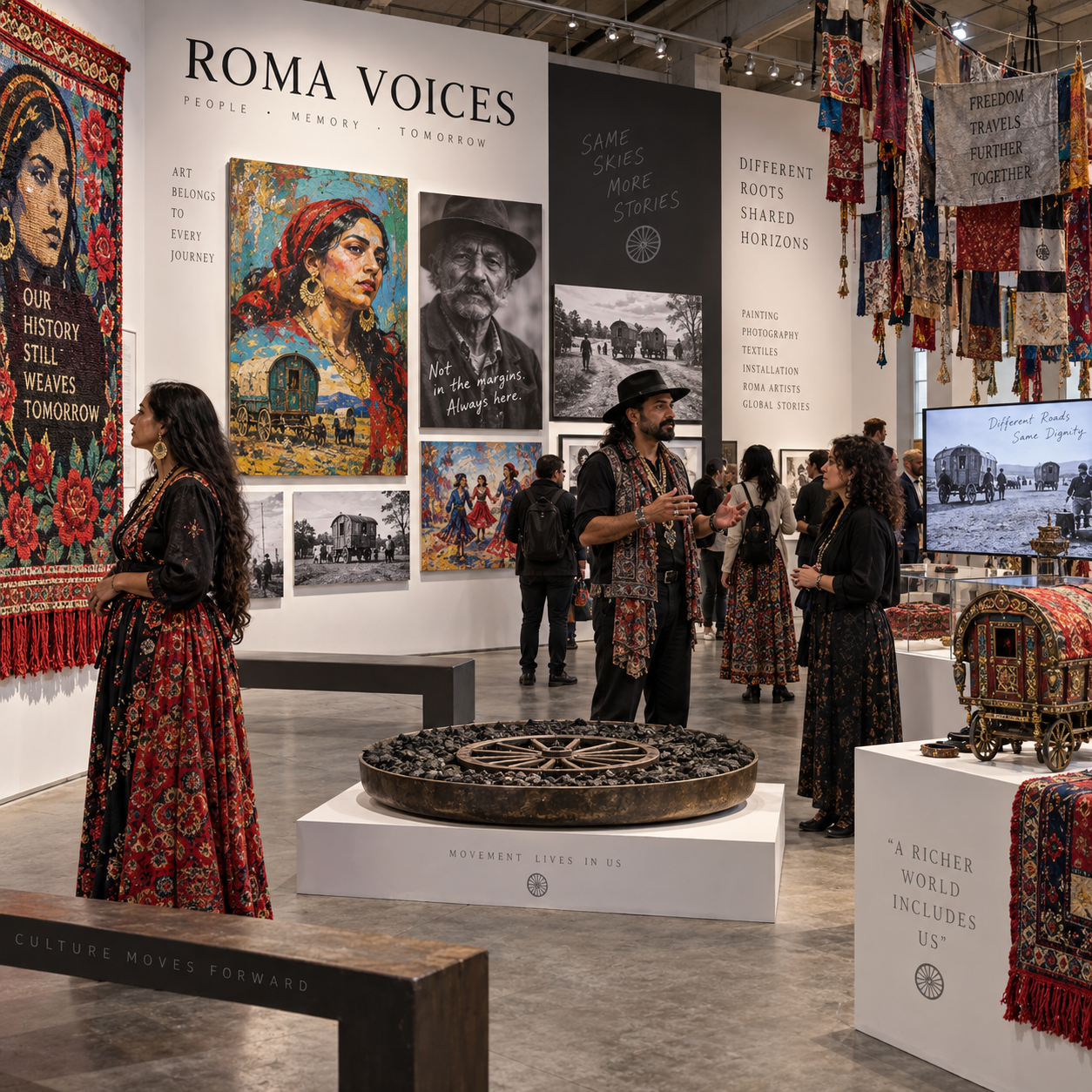
Roma art cannot be understood through a single story. It includes contemporary practices, inherited traditions, personal memories, political interventions, and experiments with form. The experiences of Roma artists are also shaped by several forces at once: gender identity, class and socioeconomic inequality, ethnic identity, nationality, generation, sexuality, and access to cultural institutions.
Intersectionality in Roma art offers a way to examine these connections without turning artists into symbols of hardship or treating Romani culture and heritage as uniform. It asks who has the opportunity to create, who is invited to exhibit, whose interpretation is considered authoritative, and how artists claim the right to define their own identities.
What Does Intersectionality Mean in Roma Art?
Intersectionality in Roma art means examining how ethnic identity, gender, class, and other social positions overlap to shape artistic experiences and representation. These forces do not operate separately; together, they influence visibility, opportunity, subject matter, and interpretation.
The term intersectionality is associated with legal scholar Kimberlé Crenshaw, who used it to describe how systems of inequality can combine in ways that are missed when categories are studied one at a time. Applied to Roma art, the framework helps explain why the experience of a Roma woman from a low-income rural community may differ from that of a Roma man with access to higher education and international art networks.
This does not mean that every artwork must be read as evidence of oppression. A painting, film, performance, or installation can explore desire, humor, abstraction, family, technology, spirituality, or landscape. Intersectional analysis simply makes the conditions around artistic production more visible.
- Ethnic identity can affect how an artist is categorized, marketed, or expected to speak for a community.
- Gender identity can influence safety, mobility, authorship, and access to professional spaces.
- Class can shape education, materials, travel, time, and relationships with galleries or curators.
- Cultural belonging can involve both attachment to Romani heritage and critical, changing relationships with tradition.
The framework therefore shifts attention from a narrow question, such as whether an artist is Roma, to a broader set of questions about power, agency, context, and artistic choice.
Roma Identity Beyond a Single Narrative
Roma identity in art is plural and changing, reflecting different histories, languages, communities, locations, generations, and relationships to Romani culture and heritage. Roma artists do not represent one uniform experience or a single cultural style.
The word Roma encompasses communities with distinct regional histories and lived realities across Europe and beyond. Some artists work closely with family archives, oral history, music, craft, or ritual. Others use digital media, conceptual art, documentary photography, sculpture, animation, or socially engaged practice. Some foreground Roma identity; others treat it as one part of a wider artistic vocabulary.
This plurality matters because cultural institutions have sometimes expected Roma artists to provide easily recognizable images of tradition or exclusion. Such expectations can narrow the field of interpretation. A textile work may be connected to memory and inherited skill, yet it may also investigate labor, migration, gendered domestic work, or contemporary design. A photographic portrait may address discrimination, but it can equally explore intimacy, performance, fashion, or self-fashioning.
Representation is also a question of authorship. Who frames the story can change its meaning. When Roma artists control the terms of presentation, they can challenge the assumption that outside researchers, journalists, or institutions should explain Roma life on their behalf.
For audiences, a useful approach is to avoid asking whether an artwork is representative of all Roma people. Instead, ask what specific experience, argument, memory, or imaginative world the artist presents, and what remains deliberately outside the frame.
Gender and Visibility in Roma Artistic Practice
Gender shapes Roma artists’ visibility, working conditions, and artistic choices by affecting access to education, mobility, cultural spaces, domestic responsibilities, and recognition. These effects can be especially complex when gender inequality intersects with ethnic discrimination and class barriers.
Women artists may encounter assumptions that their work is primarily craft, domestic production, or cultural preservation rather than contemporary art. When embroidery, clothing, jewelry, or family photographs enter a gallery, curators need to address both their formal qualities and the labor histories attached to them. Treating such work as merely decorative can reproduce the gendered hierarchy that separates craft from fine art.
Gender also influences who can travel, attend residencies, build professional networks, or participate in late-night cultural events. Care responsibilities and safety concerns may affect artistic careers in ways that remain invisible in exhibition narratives. Roma LGBTQ+ artists can face additional pressures when they navigate expectations about community, sexuality, public visibility, and institutional inclusion.
At the same time, gender should not be used to create another simplified narrative. Roma women and LGBTQ+ artists are not valuable only because they reveal marginalization. Their practices may be humorous, speculative, sensual, formalist, experimental, or confrontational. Visibility should expand artistic possibility rather than assign a required subject.
Curators can respond through practical measures: transparent selection criteria, paid participation, accessible venues, safeguarding policies, childcare support where feasible, and interpretive texts that identify artists as authors rather than as examples of a social problem.
Class, Access, and Cultural Production
Class affects Roma art by shaping access to education, materials, mobility, time, networks, and exhibition opportunities. Socioeconomic inequality can determine who is able to sustain an artistic practice long enough to be noticed by galleries, museums, biennales, or public funders.
Art production often requires more than talent. Artists may need studio space, reliable internet, equipment, transport, translation, application fees, and unpaid time for proposals and networking. A person supporting a household or living far from a major cultural center may face barriers that have little to do with creative ability.
These barriers also affect the kinds of work that become visible. An artist with limited resources may rely on low-cost photography, found materials, community spaces, or collaborative production. Those choices can be aesthetically powerful, but institutions should not romanticize scarcity. Working with inadequate resources can restrict scale, preservation, documentation, and professional development.
A useful way to assess access is the production chain:
- Entry: Who can study art, learn techniques, or find mentors?
- Production: Who has time, space, tools, and financial stability to make work?
- Visibility: Who receives invitations, reviews, residencies, and exhibition opportunities?
- Continuity: Who can keep working after a project ends?
Each stage can reproduce inequality. Grants, fair fees, local partnerships, translation, and travel support can reduce some obstacles. They do not remove structural inequality entirely, but they make participation less dependent on private wealth and informal connections.

Challenging Stereotypes Through Contemporary Roma Art
Contemporary Roma art challenges stereotypes by giving artists control over narrative, medium, and context. Artists may confront exoticized images, reject victim-only portrayals, revise historical records, or create new visions of Roma futures.
Common stereotypes reduce Roma people to folklore, poverty, criminality, mobility, or cultural difference. Art can expose the violence of these images, but it can also move beyond them. A film might focus on ordinary friendship rather than discrimination. An installation might combine family documents with speculative architecture. A performance might use humor to unsettle the audience’s expectations about authenticity.
Reclaiming representation does not require abandoning heritage. Contemporary artists can work with Romani music, language, ornament, storytelling, or craft while transforming these elements through new materials and concepts. The important question is not whether an artwork looks traditionally Roma, but how it engages with memory, belonging, power, and artistic intention.
Cultural institutions should resist packaging Roma art as a single genre. Exhibition labels can provide historical context without making social suffering the only interpretive key. They should also name the artist’s methods, references, and formal decisions. Context should deepen an artwork’s meaning, not replace close looking.
Audiences can help by questioning their first assumptions. If a work appears familiar, ask which visual expectations produced that familiarity. If it appears unfamiliar, avoid treating difference as evidence of inauthenticity. Both reactions can limit an artist’s freedom.
The Role of the Roma Art Biennale
The Roma Art Biennale can create visibility, exchange, and critical dialogue by presenting diverse Roma perspectives within an international contemporary art context. Its value depends on how it distributes curatorial authority, resources, and interpretive space.
A dedicated biennale can address a longstanding problem: Roma artists may be included in cultural programming only when institutions seek a themed contribution about diversity or marginalization. A Roma Art Biennale can establish a sustained platform where artists define the questions, forms, and conversations that matter to them.
Its strongest contribution is not simply gathering Roma artists in one venue. It is building an environment in which differences within Roma communities remain visible. Programming can include artists from multiple countries and generations, women, LGBTQ+ artists, working-class practitioners, established figures, and emerging voices. It can also connect visual art with film, performance, sound, design, archives, and community-led research.
Curatorial practice matters. Organizers should consider who selects artists, how artists are paid, whether interpretation is multilingual, and whether venues are physically and socially accessible. Partnerships with local Roma organizations can strengthen accountability, although institutions should avoid treating community groups as symbolic advisers without compensation or decision-making power.
A biennale also has a responsibility to audiences. Talks, publications, workshops, and accessible interpretive materials can encourage visitors to engage with complexity rather than consume identity as spectacle. Visibility becomes meaningful when it leads to agency, resources, and continuing relationships.
Toward More Inclusive Representation
Inclusive representation in Roma art requires institutions and audiences to recognize plurality, share authority, and support artists beyond a single exhibition. Roma identity, gender, class, and social struggle should inform interpretation without defining the full limits of an artist’s work.
Five principles provide a practical guide:
- Read specifically: Discuss the artwork’s materials, form, references, and argument rather than relying on broad cultural labels.
- Support authorship: Use the artist’s own language where possible and avoid making institutions the only source of interpretation.
- Show plurality: Present differences in nationality, generation, gender identity, sexuality, class, religion, and artistic method.
- Fund access: Provide fees, travel support, translation, equipment, production budgets, and realistic timelines.
- Plan for continuity: Build long-term partnerships, acquisitions, archives, education, and follow-up opportunities rather than one-off visibility.
Intersectionality in Roma art ultimately asks viewers to hold two ideas together: social conditions shape artistic possibility, and Roma artists remain complex authors who cannot be reduced to those conditions. The Roma Art Biennale can model this balance by making space for disagreement, experimentation, heritage, and futures that do not fit inherited stereotypes.
Frequently Asked Questions
What is intersectionality in the context of Roma art?
It is an approach that examines how ethnic identity, gender, class, sexuality, nationality, and other factors overlap in shaping Roma artists’ experiences, opportunities, and representation.
How does gender shape Roma artists’ experiences?
Gender can influence access to education, mobility, safety, care responsibilities, cultural networks, and recognition. Women and LGBTQ+ artists may also challenge expectations about tradition and visibility.
Why does class matter in the visibility of Roma artists?
Class affects access to training, studio space, materials, travel, digital tools, unpaid applications, and professional networks. These conditions influence who can sustain a career and reach institutions.
How can Roma art challenge stereotypes?
Artists challenge stereotypes by reclaiming authorship, using contemporary media, revising historical narratives, presenting ordinary and complex lives, and refusing to make poverty or folklore their only subject.
What role can the Roma Art Biennale play in inclusive representation?
It can provide visibility, fairer access, international exchange, and a platform for diverse Roma voices. Its success depends on shared curatorial authority, adequate resources, accessibility, and long-term support.