Memory and Trauma in Contemporary Roma Visual Narratives
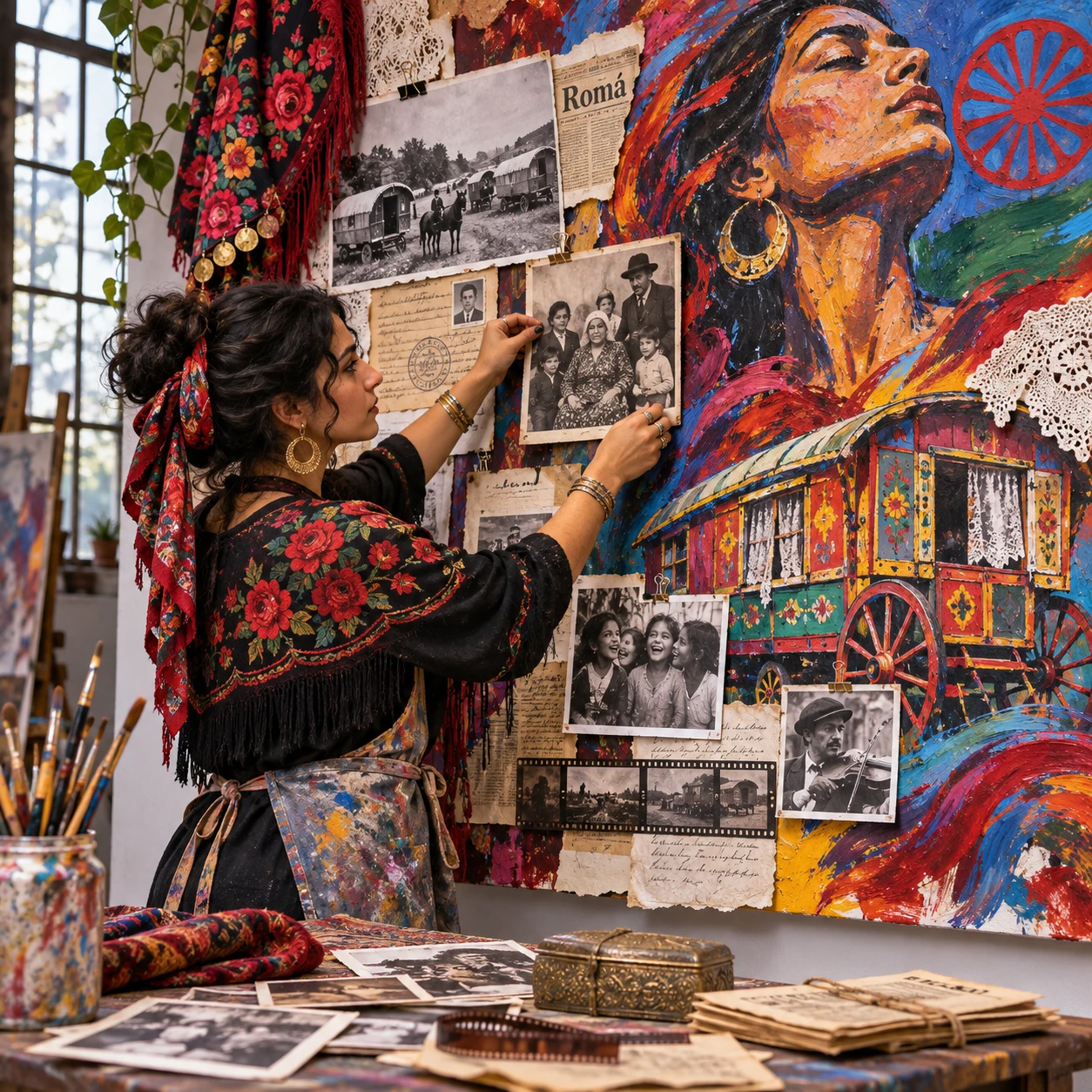
Memory and trauma in contemporary Roma visual narratives are ways artists can examine identity, history, and belonging on their own terms. Through painting, photography, installation, film, and other forms, Roma artists may bring personal and collective histories into view while also making space for humor, beauty, everyday life, and possibility.
There is no single Roma experience, and no single visual language represents it. Artists make different choices about what to recall, what to question, and what to leave unspoken. Reading this work with care means attending both to the histories it evokes and to the creative agency shaping the image.
Why Memory Matters in Roma Art
Memory matters in Roma art because it can connect personal identity with family history, community knowledge, and a sense of belonging. In contemporary Roma art, remembering may be an act of inquiry, a way to preserve what has been overlooked, or a means of imagining a future informed by the past.
Memory is not simply a record of events. It can be carried through photographs, objects, gestures, stories, music, places, and gaps in the archive. An artist might return to a family image, reinterpret a familiar symbol, or use an empty space to suggest what cannot be recovered. These approaches can make history present without claiming that one artwork speaks for every Roma person.
Collective memory also changes across generations and communities. What a grandparent remembers directly may reach a younger relative through conversation, silence, or an object kept at home. Visual narratives can hold these different forms of knowledge together, including uncertainty about what happened and how it was understood.
For audiences, the key is to look beyond the question, “What does this image say about Roma people?” A more useful question is, “Whose memory is being expressed, and what choices has the artist made about its telling?”
Representing Trauma Without Reducing Roma Experience
Visual art can address trauma without defining Roma experience by suffering when it gives artists control over perspective, context, and emphasis. A work may bear witness to harm while also showing relationships, cultural continuity, humor, resistance, or ordinary life.
Trauma can appear directly, through images of violence or displacement, or indirectly through fragmentation, repetition, absence, and disrupted time. These are possible artistic strategies, not universal signs with fixed meanings. The interpretation depends on the work, its maker, and the context in which it is shown.
A common risk in presenting art about painful histories is to make suffering the only story an audience can see. That framing can echo stereotypes even when the intention is sympathetic. Curators and writers can avoid this by identifying the artist and their choices, providing relevant context, and resisting claims that one image represents an entire community.
Viewers should also avoid treating every formal choice as evidence of trauma. A fractured composition may reflect experimentation or aesthetic preference; it does not automatically reveal biography. Respectful interpretation leaves room for ambiguity and does not demand personal disclosure from an artist as the price of understanding the work.
Personal Stories, Collective Histories
Personal stories connect with collective histories when visual narratives show how memory travels through families, relationships, and communities. An individual image can suggest wider histories, but it remains grounded in a particular person’s experience rather than serving as a complete account of Roma life.
Intergenerational storytelling often works through small details: a portrait passed between relatives, a repeated phrase, a place described but no longer visited, or an object whose meaning changes over time. Artists may use these fragments to explore what can be transmitted and what becomes difficult to say. The result can be a conversation between generations rather than a tidy timeline.
This approach also challenges the assumption that history exists only in official records. Personal photographs and spoken accounts can preserve lived experience, while gaps in documentation can raise questions about who collected, classified, or excluded certain stories. An artwork may place family memory beside archival material, inviting viewers to notice where the accounts meet or diverge.
Still, private memory should not be treated as interchangeable with collective memory. Roma communities are diverse, and an artist’s family story has its own boundaries. A careful reading recognizes the wider resonance of personal narratives without turning one person’s life into a universal symbol.
Visual Strategies of Remembrance
Visual strategies of remembrance may include symbolism, archival material, portraiture, and mixed media, among many other approaches. These techniques offer artists ways to explore memory and trauma, but none is a required or uniquely Roma style.
Archival photographs can bring questions of evidence and authorship into the work: who made an image, who preserved it, and how it is being seen now? Portraiture can affirm presence and individuality, especially when a sitter is presented with dignity and complexity rather than as an anonymous type. Symbolic objects may carry intimate meanings that are not immediately visible to an outside audience.
Mixed media can place different kinds of evidence in conversation. Paint, text, found materials, sound, or projected images may create layers that resemble how memories overlap and change. Other artists may choose spare forms, vivid color, abstraction, or scenes of daily life. Those choices deserve attention on their own terms, rather than being read automatically as signs of historical pain.
When encountering a work, try a simple three-part reading: notice the material, ask what kind of memory it makes available, then consider what remains outside the frame. This approach supports close looking without forcing a single interpretation.
Self-Representation and Challenging Stereotypes
Self-representation gives Roma artists agency to shape how Roma identity is pictured, discussed, and understood. It can challenge images imposed from outside while allowing for disagreement, experimentation, and many different accounts of belonging.
For generations, images and descriptions of Roma people have often been shaped by outsiders and simplified into familiar stereotypes. Contemporary Roma visual narratives can answer those frameworks, but they need not make a direct rebuttal their only purpose. An artist might depict a family, a city, a private interior, or an imagined world without explaining Roma identity for a general audience.
That freedom matters. Self-representation is not a demand that every Roma artist produce cultural testimony, nor does it make any one artist a spokesperson for all Roma communities. It means recognizing the artist as a maker with control over subject, form, and meaning.
Audiences and institutions share responsibility for how work is presented. Labels should use accurate language, avoid treating Roma identity as a visual style, and include the artist’s own framing where available. This helps keep interpretation grounded in the artwork instead of letting old assumptions fill the gaps.
The Roma Art Biennale as a Space for Dialogue
The Roma Art Biennale can create space for dialogue by presenting contemporary Roma creativity and bringing artists, audiences, and cultural institutions into contact. Its value lies in making room for diverse work and perspectives, not in presenting a single definition of Roma art.
In a biennale setting, works about memory and trauma can appear alongside pieces concerned with identity, place, abstraction, or everyday life. That breadth matters: it allows audiences to encounter historical reflection without treating it as the only subject Roma artists address. Exhibitions can also encourage conversation about who interprets cultural work and how institutions can support artists without narrowing their practice.
Dialogue works best when it is specific. A useful discussion might ask how an artist uses an archive, how a work shifts between personal and public memory, or what a particular installation asks viewers to notice. These questions invite attention to artistic decisions rather than turning the exhibition into a test of whether Roma identity has been adequately explained.
For visitors, a thoughtful approach is simple: read the artist’s framing, look closely before reaching for familiar labels, and allow a work to remain open where its meaning is not settled. The Roma Art Biennale can support that encounter by making space for complexity, cultural exchange, and artists’ own narratives.